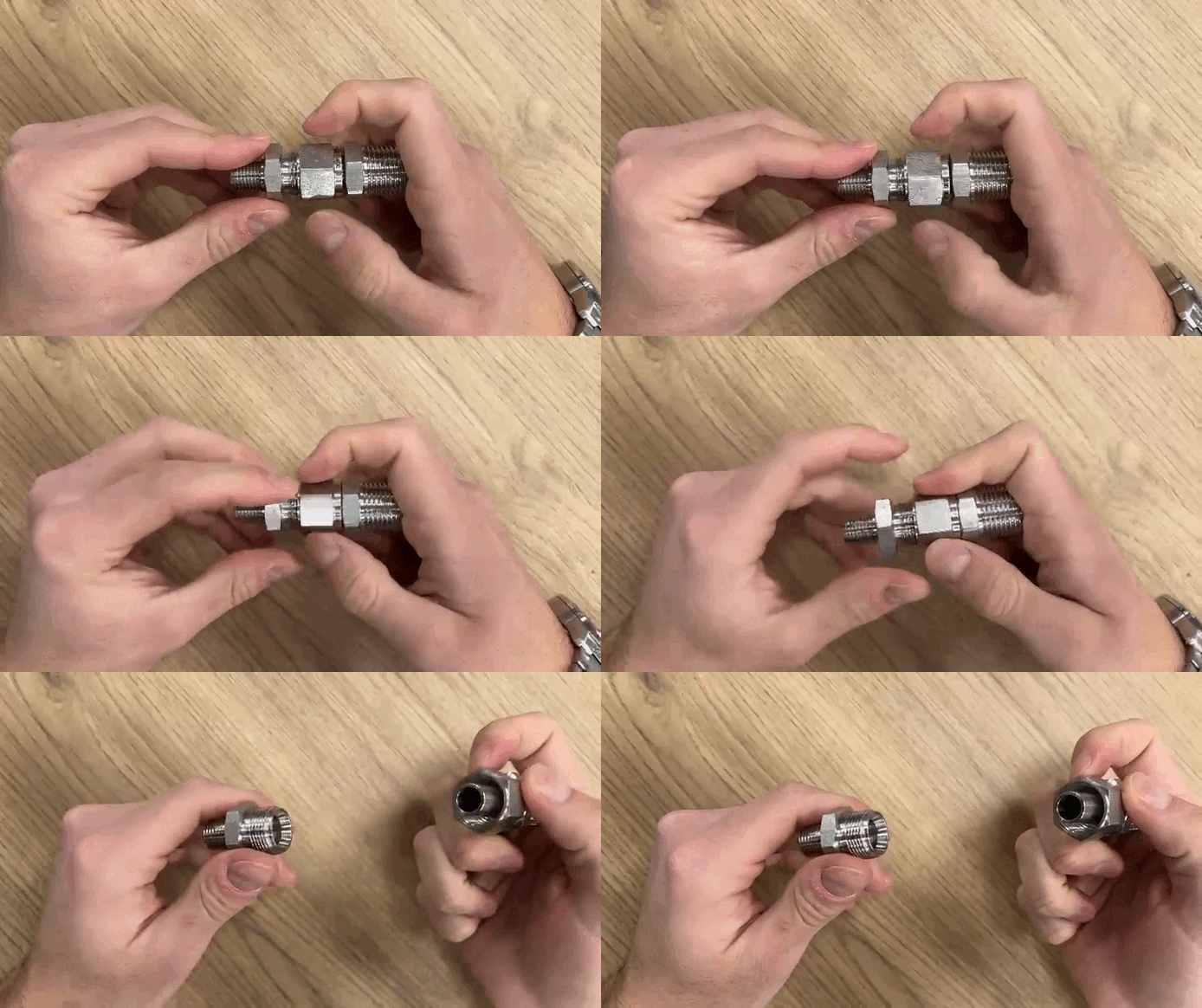
Imagine you’re installing a pressure gauge on a pipeline and, as you screw it in, you realize that when it finally tightens… the dial is facing the wall! If you loosen it a bit to reorient it, you’ll lose sealing; if you tighten it further, you might strip the threads. This issue is more common than it seems: NPT tapered threads tighten at a random point, determining the final orientation of the instrument. The traditional solution with parallel threads? Use a swivel nut (also known as a rotating nut or union nut), which allows you to tighten the connection without turning the body of the instrument.
But do swivel nuts exist for NPT threads?
Here’s the short answer: by definition, standard “true” NPT swivel nuts don’t exist, due to the nature of the tapered thread. However, at Redfluid we have a practical solution that lets you freely orient your NPT-threaded instruments.
In this article, we’ll explain in a clear, friendly way what a swivel nut is, what it’s used for, the most common types, and how we achieve a “swivel nut” effect even with tapered NPT connections—plus an explanatory video where you’ll see it in action. Let’s get into it!
What is a swivel nut or “floating female” nut?
A swivel nut is a fitting component designed to make it easier to connect pipes or instruments without having to rotate the entire part. Basically, it’s a female connection with a free-spinning lock nut: it lets you thread and tighten the joint by turning only the outer nut, while the other part of the fitting (the inner body) stays stationary.
In other words, it works like a garden hose connector: when you attach the hose to the tap, you turn the nut at the end of the hose instead of twisting the whole hose. In the same way, a swivel nut in instrumentation lets you tighten a connection without twisting the pressure gauge, valve, or component connected at the other end. This is crucial when that device must end up correctly oriented (for example, with the gauge dial facing the operator).
What is a swivel nut used for?
Mainly, for two purposes:
To orient instruments or accessories (pressure gauges, transmitters, valves, etc.) in the desired direction, even after fully tightening them, avoiding unwanted orientations.
To make installation and removal easier for components that cannot rotate on themselves (because they’re fixed in a rigid line or have wiring attached), since the swivel nut provides the necessary independent rotation.
In short: swivel nuts allow 360° orientation of an instrument or fitting during installation. This makes assemblies more comfortable, faster, and free of frustration from upside-down readings or twisted tubing.
Common types of swivel nuts and available thread options
On the market, you’ll find several types of swivel nuts, usually classified by the thread combinations they connect:
Female–Female swivel: both ends have female threads, with one side incorporating the swivel nut. Very common for joining tubing sections without having to rotate them.
Female–Male swivel: one end is a fixed male thread and the other end is a swivel female nut. For example, a swivel BSP female x 60° tapered BSP male is a typical adapter in instrumentation.
Male–Male swivel: less common; it’s a fitting where one male end can rotate freely (it usually requires a special design with an internal seal).
These combinations can be made across different thread standards. The most common swivel nuts are based on parallel threads (such as BSP or metric) that seal with a washer, a cone seat, or a gasket. For example, it’s easy to find swivel BSP female x NPT male adapters to connect a tapered-thread gauge to a BSP port, taking advantage of the fact that the BSP side can be swivel thanks to a sleeve and internal seat. Tapered NPT threads, however, pose a specific challenge for this kind of swivel connection—as we’ll see next.
Do swivel nuts exist with NPT threads?
That’s the key question. Because NPT is a tapered thread, it seals by interference: as you tighten it, the threads wedge together and become leak-tight thanks to the conical shape of the thread flanks (often helped by thread sealant or PTFE tape). In a swivel nut, the rotating part is independent from the body, so it can’t “bite” into the tapered thread to create a seal—because it would just spin freely without ever properly engaging the taper.
In other words, if we made a conventional swivel female NPT nut, when you threaded it onto an NPT male it would never achieve a leak-tight seat: the nut would bottom out before the threads seal, or it would remain loose.
For this reason, you won’t find “standard NPT swivel nuts” in catalogs. Any swivel solution for tapered NPT connections requires a special design with additional internal parts to achieve sealing.
Redfluid’s solution: a swivel adapter for NPT
At Redfluid, we’ve developed a clever NPT swivel adapter that does exactly what many users need: it lets you connect an instrument with a tapered NPT thread and then adjust it to the desired orientation while maintaining leak-tight sealing. How do we achieve this? Let’s break it down.
Special “swivel nut” adapter for NPT, made in stainless steel. It consists of two threaded sections and an outer nut that allows free rotation; once the instrument is correctly oriented, the nut is tightened to lock the position.
The adapter consists of two halves joined by a central swivel nut:
One half has, for example, an internal female NPT thread (where you would screw in the male-thread pressure gauge). This side fully mates with the instrument and includes a special sealing element (e.g., a PTFE ring or a cone seat).
The other half provides an external male NPT thread (to screw into the pipe or equipment). This side is installed fixed on the line, like a standard adapter.
Between both halves, a swivel nut connects them: when it’s loose, it allows the two halves to rotate freely relative to each other. This makes the installation procedure:
Thread and tighten the corresponding half into the line or equipment (for example, the male NPT into the pipe).
Thread the instrument (pressure gauge) into the adapter’s female half and tighten it properly. Its final orientation doesn’t matter at this stage.
Join both halves, keeping the nut loose while you rotate the gauge to the optimal reading position. You can turn it 360° freely.
Finally, tighten the adapter’s swivel nut. This activates the internal sealing mechanism (cone, flat gasket, or O-ring), ensuring a leak-tight seal between the two halves and locking the chosen position. Problem solved!
The result is functionally equivalent to having an “NPT swivel nut.” This rotating assembly provides the flexibility you want: your gauge ends up facing forward, properly secured, leak-free—and without fighting with a wrench in impossible positions.
Advantages and applications of the NPT swivel adapter
Implementing this “swivel nut” solution for NPT connections brings several key benefits:
Easy, safer readings: You can orient pressure gauges and indicators to face forward, avoiding awkward viewing angles. This improves ergonomics and reduces reading errors.
Effortless installation: No more dismantling half the system or juggling elbows and PTFE tape to get the right position. The adapter simplifies assembly, saving time and frustration.
Connection versatility: We can supply the adapter in different configurations (female–male, male–male, female–female) and NPT sizes (typically 1/4” and 1/2”, others on request) to match your needs. It’s also useful for other tapered connections where orientation matters.
No leaks, no stress: By avoiding over-tightening to “force” alignment—or leaving fittings “half-tightened”—you ensure optimal sealing without stressing the instrument or the tubing. That means lower leak risk and less chance of mechanical damage.
Robust materials: Our swivel adapters are made in 316 stainless steel, suitable for high pressures (up to 6000+ psi) and corrosive environments, ensuring reliability in petrochemical, food, pharmaceutical industries, and more.
In short, if you’ve ever wondered, “Why can’t my NPT gauge end up straight?”—here’s the reason and the fix. With this special swivel adapter, the fact that NPT is tapered no longer matters: you can orient your instruments however you want, whenever you want, without losing sealing (or your patience).
Want more information?
If you need a special configuration or advice on selecting the right adapter, contact Redfluid—our technical team will be happy to help.
And remember: we also offer a wide range of high-pressure fittings, valves, and accessories to solve any connection challenge in your installations. See you next time!
Sounds familiar? The technician looks for a fitting, maintenance can’t find it, purchasing places an urgent order “for yesterday”… In the end, production gets delayed,
What is Type Approval for marine and offshore components, and why does it matter? Type Approval is a certification process by which a classification society