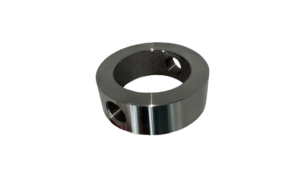
Flushing Ring: the key to cleaning and calibration without disassembly
Imagine you’re running an industrial plant and you’ve got a diaphragm seal protecting a pressure transmitter. Over time, the process fluid starts leaving deposits and

I usually explain it like this: if you have several valves, adapters, and connections at an instrument point just to perform something as basic as isolation and venting, that assembly can probably be simplified. And that’s exactly where a flanged manifold or compact instrumentation manifold comes into play.
We’ve also included a 3-minute video where we visually explain what a monoflange is and what it’s used for.
In industrial plants, the need is very clear: isolate a pressure gauge or transmitter from the process and vent the line before performing maintenance. This makes it possible to inspect, calibrate, or replace the instrument in a much safer and more controlled way. Redfluid manifolds are specifically designed for isolation, venting, blocking, calibration, or pressure equalization, depending on the application.
When this function is achieved using separate components, the assembly becomes larger and more complex. More fittings mean more potential leak points, more internal volume, and a higher risk of mistakes during assembly or ordering.
That’s why, when we recommend a flanged manifold, it is usually to simplify the entire assembly and bring the isolation and venting functions directly to the instrument itself. This simplification is a direct result of the compact block design used across the Redfluid manifold range.
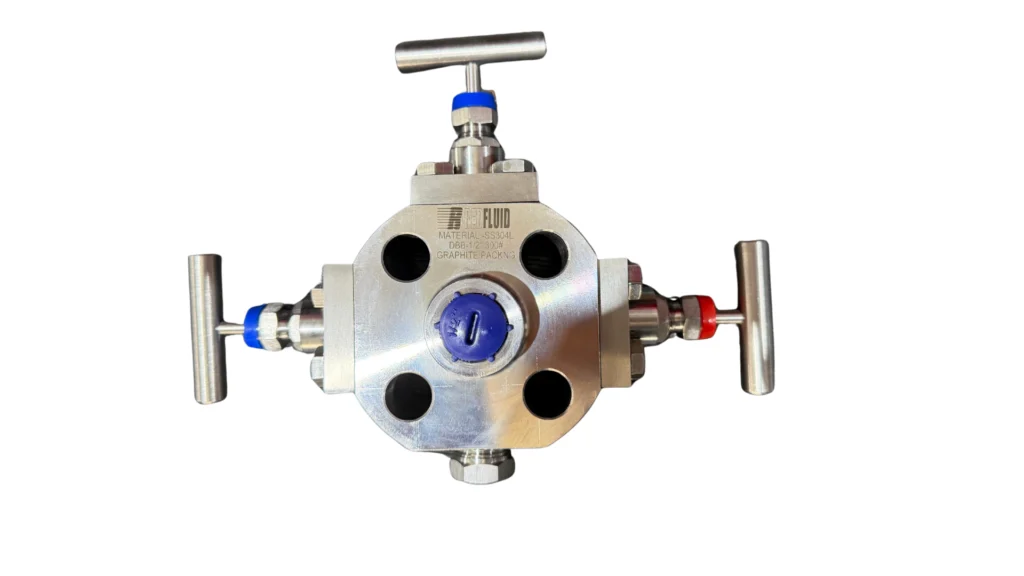
Put simply, a monoflange is a compact instrumentation manifold with a flanged interface, designed to integrate into a single body functions that were previously distributed across several valves and fittings.
In many installations, it is mounted between the process flanged connection and the instrument, or very close to the instrument in a direct-mount configuration. The idea is not to “add another valve,” but to provide a cleaner and more efficient solution for the process-to-instrument connection, isolation, and venting functions. In fact, Redfluid distinguishes between direct-mount manifolds with standardized transmitter flanges and remote manifolds with threaded connections.
A quick way to understand it is this:
| Configuration | What it does | Typical application |
|---|---|---|
| 1 valve | Simple isolation | When you only need to isolate the instrument from the process |
| 2 valves | Isolation + venting | To shut off the process and vent the line before inspection or calibration |
| 3 valves | Double block and bleed, or double isolation with an intermediate function depending on the design | When you need a safer operation or an additional instrumentation function |
This table summarizes the functional logic described in Redfluid documentation for 1, 2, 3, and 5-valve manifolds, as well as in general technical literature related to compact monoflanges.
There is an important nuance here that should be clarified to avoid confusion between concepts. In conventional manifolds for differential pressure applications, a 3-valve manifold usually consists of two isolation valves and one equalizing or bypass valve used for zero balancing. Redfluid explains it this way in its differential pressure transmitter manifold designs.
However, in the context of this article — focused on monoflanges / flanged manifolds for process taps and instrumentation — users often refer to a compact double block and bleed configuration with two shut-off valves and one vent valve as a “3-valve” setup. That is why it is always important to review the actual assembly drawing before ordering.
This is the important part. Double block and bleed means you are not relying on a single isolation barrier. You have two blocking points and a bleed valve in between them to safely depressurize the trapped section before carrying out maintenance. In practice, this is the operating logic behind a double block and bleed valve or a DBB manifold. The explanation of this concept in the context of a monoflange is based on the functional logic described by Redfluid for isolation and venting applications, together with general technical literature from the industry.
So where is the real value? In being able to work with greater safety and confidence. If one sealing barrier does not perform perfectly, there is still a second barrier in place. And on top of that, the bleed valve allows the intermediate cavity to be depressurized safely.
This is not just catalog theory. It is a much more sensible safety approach when dealing with demanding services or when the instrument is installed in a location that is difficult to maintain. This interpretation is technically consistent with the way block and bleed manifolds are commonly used in instrumentation systems.
This is where we usually see the most mistakes.
It is not enough to simply request “a monoflange.” You need to review the ASME / EN flange rating, the instrument flange connection, the flange facing type, and the material selection.
If the process side is based on the ASME system, the usual reference standard is ASME B16.5. This standard covers pressure-temperature ratings, materials, dimensions, tolerances, marking, and testing requirements for flanges and flanged fittings from NPS 1/2 to 24.
If the project follows EN standards, then EN 1092-1 must be checked instead. This standard defines steel flanges from PN 2.5 up to PN 400, including facing types, dimensions, and surface finishes. And there is one very practical detail here: as Redfluid often highlights, DIN/EN and ASME standards are not directly interchangeable.
If the instrument is installed in a direct-mount configuration, it is also important to carefully verify the instrument flange connection. The most common reference for the bolted interface used with differential pressure transmitters is IEC 61518, which defines the mounting dimensions for flanged manifolds up to 413 bar. Redfluid also references this standard when explaining how to correctly select manifold connections.
Then there is the flange facing type. If the drawing specifies a raised face (RF), it must be respected. This is not a minor detail. It is part of the sealing system itself and directly affects gasket and counter-flange compatibility. Both ASME B16.5 and EN 1092-1 specifically define flange facing types and gasket seating surface finishes.
The same applies to materials. Depending on the service conditions, there is a big difference between selecting 304, 316, 316L, duplex stainless steel, or special alloys. Redfluid manufactures manifolds in stainless steels, carbon steel, and high-performance alloys, and also provides technical guidance on the practical differences between 304 and 316 stainless steel.
When we help configure a manifold, we do not just look at “which valve fits.” We review the process media, corrosion risk, operating temperature, and traceability requirements as part of the selection process.
If you want, we can also provide the technical datasheet so you can review connections, materials, and typical configurations before requesting a quotation.
What you notice most with a good monoflange is how much cleaner and more organized the assembly becomes. Fewer components. Shorter overall length. Fewer doubts during installation. This improvement in compactness is a direct result of integrating several functions into a single block.
You also notice the difference during maintenance. When it is clear where the isolation point is and where the venting point is, field work becomes much more straightforward. And when the instrument is installed in a difficult position, that makes a huge difference.
If you still have questions, we will continue explaining these cases step by step on our blog, because in the end, the important thing is not the commercial name — it is whether the solution truly fits the installation.
At Redfluid, we offer 1, 2, and 3-valve manifolds for direct or remote mounting, with NPT, BSP, or flanged connections, IEC 61518 compatibility, standard materials in 316/316L stainless steel, alloy options, and customized configurations whenever the project requires it.
This fits perfectly with what customers are usually trying to solve: “I need to properly configure this process tapping point.” Sometimes the customer specifically asks for a monoflange. Other times they ask for a 2-valve or 3-valve manifold. And sometimes they simply ask for a double block and bleed valve for flanged instrumentation.
But in the end, they are almost always trying to solve the same problem: isolate, vent, reduce assembly size, minimize potential leak points, and avoid flange compatibility mistakes.
We hope this article has helped you better understand when a monoflange makes sense, the difference between a block-and-bleed and a double block and bleed configuration, and why a properly selected flanged manifold can save you problems related to installation, maintenance, and safety.
If you need to install flanged instrumentation and are not sure which configuration is best for your application, tell us about your project. With the instrument type, flange specification, pressure, process fluid, and material requirements, we can help you define whether you need a simple monoflange, a DBB manifold, or a 2 or 3-valve manifold — fully configured and ready for your installation.
Imagine you’re running an industrial plant and you’ve got a diaphragm seal protecting a pressure transmitter. Over time, the process fluid starts leaving deposits and
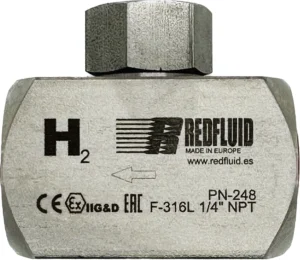
Imagine installing just any check valve in a hydrogen circuit. At first, everything seems to work fine — but over time, internal materials begin to